

The Great Pool & Orange Gardens
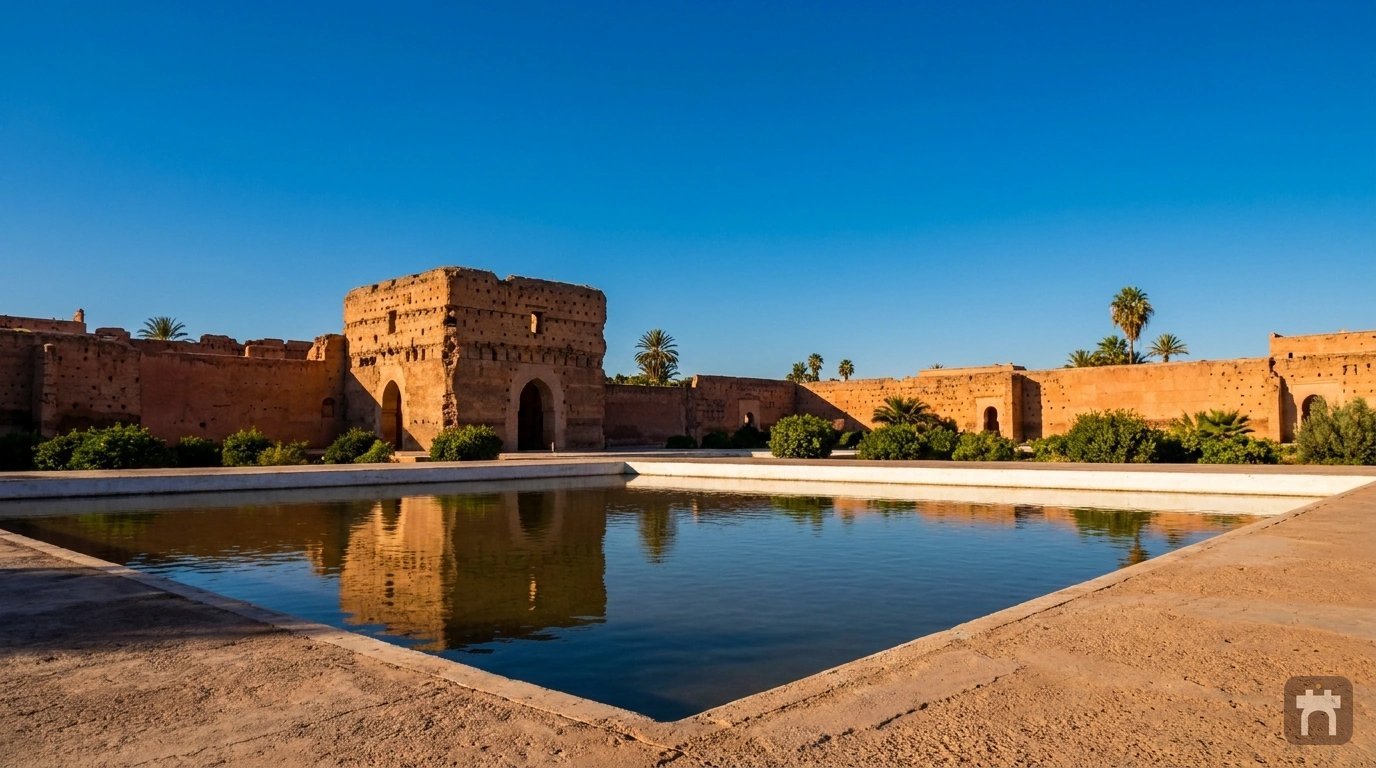
A reflecting pool nearly 90 metres long anchors the main courtyard, flanked by sunken gardens planted with orange trees — the heart of al-Mansur's original design.
Marrakech · Kasbah district · since 1578
Marrakech's magnificent ruin — a 16th-century Saadian masterpiece stripped of its treasures, now alive with storks and shadows.
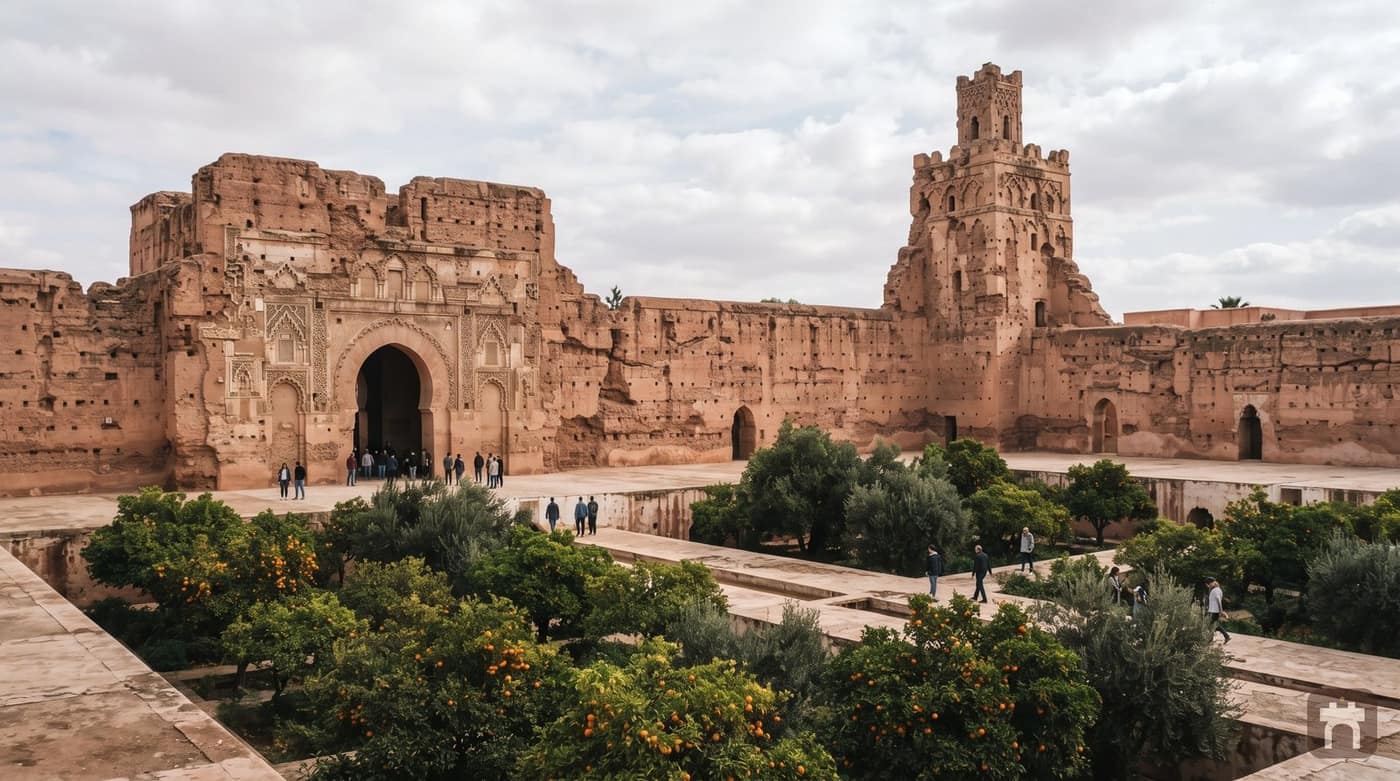
In 1578, fresh from his victory at the Battle of the Three Kings, the Saadian sultan Ahmad al-Mansur set out to build a palace that would announce Morocco's new power to the world. He called it El Badi — "the Incomparable" — and for roughly twenty-five years, caravans crossed the Sahara carrying gold from Timbuktu while Italian merchants shipped Carrara marble to Marrakech in exchange for Moroccan sugar. When it was finished, El Badi held some 360 rooms arranged around a vast courtyard measuring 135 by 110 metres, its sunken orange gardens framing a reflecting pool nearly 90 metres long.
The palace's glory did not last. Barely a century after it was completed, Sultan Moulay Ismail ordered it stripped bare to build his new capital at Meknes — marble, cedar beams, gold leaf, and tilework were carted north piece by piece, leaving behind the roofless pisé walls that stand today. What remains is less a monument to Saadian wealth than to its undoing: a vast, sun-bleached ruin where white storks now nest on the ramparts, and where, inside a small pavilion, the exquisite 12th-century Koutoubia minbar survives as a reminder of just how much finer craftsmanship once filled these walls.
A reflecting pool nearly 90 metres long anchors the main courtyard, flanked by sunken gardens planted with orange trees — the heart of al-Mansur's original design.

Inside a dedicated pavilion, marvel at the 12th-century minbar carved in Córdoba for the Koutoubia Mosque — one of the finest surviving pieces of Almoravid-era woodwork.

White storks have nested on El Badi's earthen walls for generations, turning the ruined battlements into one of Marrakech's most photographed wildlife sights.

Climb to the rooftop terrace for a panorama stretching to the Atlas Mountains, then descend into the palace's cool underground passages and storerooms.
Opening Hours
9:00 AM – 5:00 PM daily (last entry 4:30 PM)
Entry Price
100 MAD for foreign visitors
Suggested Duration
1–1.5 hours
Location
Ksibat Nhass, Kasbah district, Marrakech
El Badi Palace sits in the heart of the Kasbah district, within easy walking distance of two more Marrakech icons.
The lavishly restored burial chambers of the Saadian dynasty, hidden for centuries and rediscovered in 1917.
10-minute walkA 19th-century vizier's palace celebrated for its painted cedar ceilings and tranquil courtyards — a lavish counterpoint to El Badi's bare ruins.
Every option below is a visit to El Badi Palace itself, from a self-guided entry with an audio guide to a private walk-through with a live guide. Fixed prices, booked and paid securely.
Enter at your own pace with a digital audio guide.
from €10
Get TicketsA guided walk through the main courtyard and ramparts.
from €25
Get TicketsThe Saadian Tombs and El Badi Palace, with a guide. Entry tickets to both monuments included. Minimum 4 people.
from €39
Get TicketsA private walk-through, including the rooftop terrace.
from €49
Get TicketsSold by MarrakechLocal LLC. Not affiliated with the monument, its management, or the Moroccan Ministry of Culture.

September 3, 2026
Built by the same dynasty, eight minutes apart — one an empty ruin, the other intact and decorated. How to choose, and why you probably should not have to.
Read More
August 15, 2026
What wheelchair users and visitors with limited mobility should know about El Badi Palace: the flat courtyard, the stairs to the terrace and underground gallery.
Read More August 15, 2026
How long to spend at El Badi Palace: 30 minutes for the courtyard, an hour for the main sights, 90 minutes to see the underground gallery and terrace too.
Read More